Haiku turns thousands of media sources into strategic intelligence in seconds.
Track narratives. Detect risks. Brief your team with data, not guesses.
What sets Haiku apart
Most media monitoring tools tell you what was published. Haiku tells you what it means, where it's going, and what to do about it. Six capabilities you'll find together nowhere else.
Want to see all six in action?
Who it's for
Know how your policies land
before the morning briefing.
Track public sentiment across every outlet. Detect reputational risks early. Brief your communications team with data, not guesses.
Manage every client.
Deliver in minutes.
Multi-client workspace, cross-outlet analysis, branded reports — what used to take days, done in seconds.
Brand, competitors,
industry — one view.
Detect narrative shifts before they become crises. Measure earned media value in real time.
See topics trend
before they peak.
Monitor how competitors frame the same story. Find coverage gaps before anyone else does.
Track your causes.
Prove your impact.
Identify allies and critics. Measure campaign reach with objective, data-driven evidence.
If your organization cares about what the media says — this is for you.
How it works
Three steps. No manual tagging, no overnight delays, no consultants needed.
You pick the outlets you care about, or auto-discover them from a global catalog of 7,000+ ranked sources. National, regional, specialized, social.
The moment an article is ingested, it is scored for sentiment, tagged with concepts and entities, and grouped into narratives — automatically, continuously.
You get signals, dashboards, and one-click PDF reports — exactly when you need them. Brief your team with evidence, not impressions.
Platform capabilities
Connect any media source — national, regional, specialized, or international. Auto-discover what you're missing from a global catalog of 7,000+ ranked outlets. Every source you add is tracked for health, frequency, and reliability, so your monitoring never has gaps.
The press is lukewarm and the audience is angry. It hasn’t reached the media yet.
Follow the public profiles of your institution and of the actors that matter to you on LinkedIn, Facebook, Instagram, TikTok and X. Haiku doesn’t hand you a feed of likes: it tells you which topics you pushed and which ones the press picked up, how many hours of lead you had, and where the audience has already moved while the media hasn’t. Comments are analysed for topic and mood — and stored anonymised by design: the table has no columns for author, text or link.
3 papers · 2 patents · no press coverage yet
14 papers · 31 articles · national lens on
2 of 17 actors are from the region
Define your critical factors and Haiku tracks papers, preprints, patents, code repositories and specialised press — OpenAlex, arXiv, Crossref, Semantic Scholar, Lens, GitHub and GDELT. Each topic is placed by maturity and momentum, so you see what is still a weak signal and what is already being adopted. And it flags the national lens: which of it has actors from Costa Rica and Central America.
The moment an article is ingested, AI scores its sentiment, extracts strategic concepts, identifies named entities, and assigns a category. No manual tagging, no delays. Analysis that runs continuously while your team sleeps.
Haiku doesn't just alert you — it reasons. Signals include detected risks, emerging opportunities, trending topics, likely escalations, coordinated narratives, and conspicuous silences. Each with evidence and a recommended response.
Accelerating across 8 outlets in 48h. Recommended: prepare institutional response.
No institutional voice in 12 articles this week. Window to position a message.
5 outlets using identical framing. Likely coordinated. Monitor for amplification.
Track any organization or public figure through keyword-based news monitoring. Haiku automatically maps who appears alongside your monitored entities across articles — revealing the relationships, alliances, and influence patterns no manual analysis would catch.
Every source, keyword, concept, and entity has its own analytics panel. Cross-variable tables show how each outlet covers each of your topics with full sentiment breakdown. Build your own report templates with drag-and-drop and export to PDF in seconds.
| Source | Art. | Tone |
|---|---|---|
| National Daily | 34 | |
| Digital News Hub | 28 | |
| Regional Tribune | 22 |
Track bills in the SIL — the Legislative Assembly’s information system — by number, or let Haiku find them for you: every day it matches your keywords against new bills and suggests the ones that concern you. When a bill moves — to committee, to a ruling, to the floor — you know the same day, with the full timeline next to the press coverage of the topic.
Referred to committee
Today · Economic Affairs
Published in La Gaceta
9 days ago
Bill introduced
21 days ago
A haiku has three lines. So does our promise.
See everything.
Understand what matters.
Act first.
Three steps. One discipline. The difference between drowning in headlines and leading the conversation.
A dedicated intelligence engine computes more than 90 KPIs (key performance indicators) daily across every domain that matters to your institution — from visibility and narrative control to crisis exposure, press freedom indicators, and media reach.
What your team receives
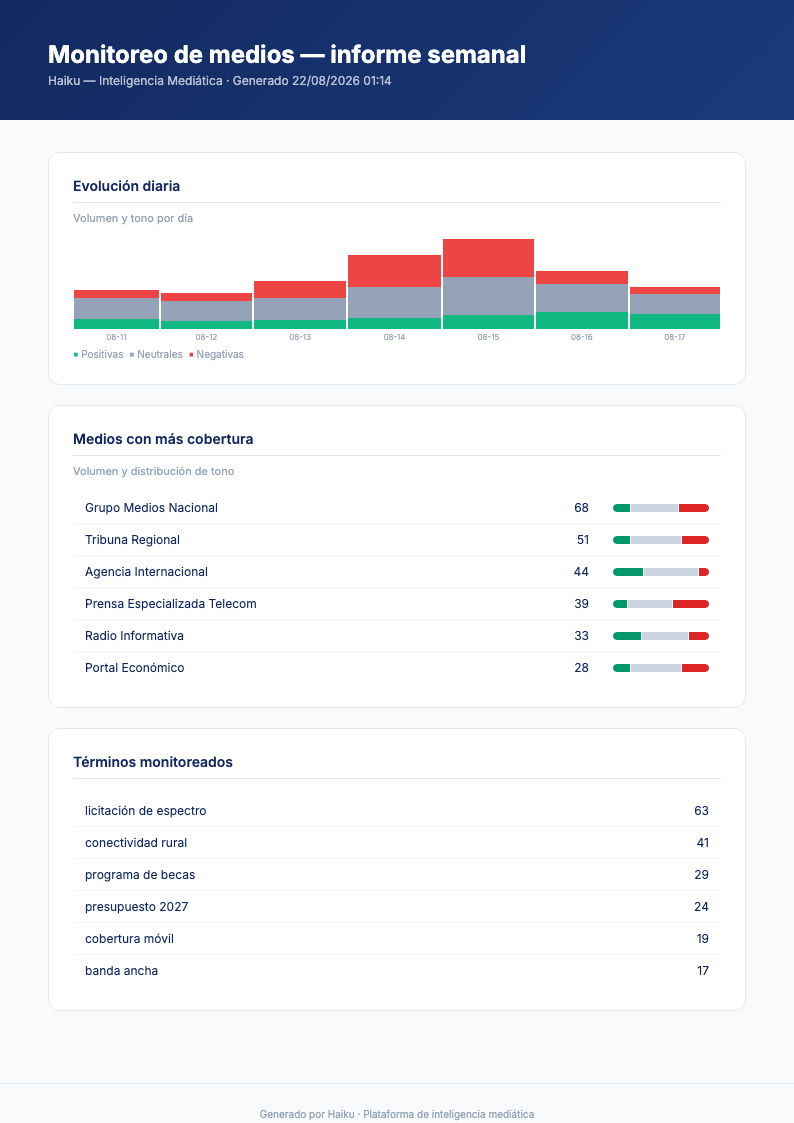
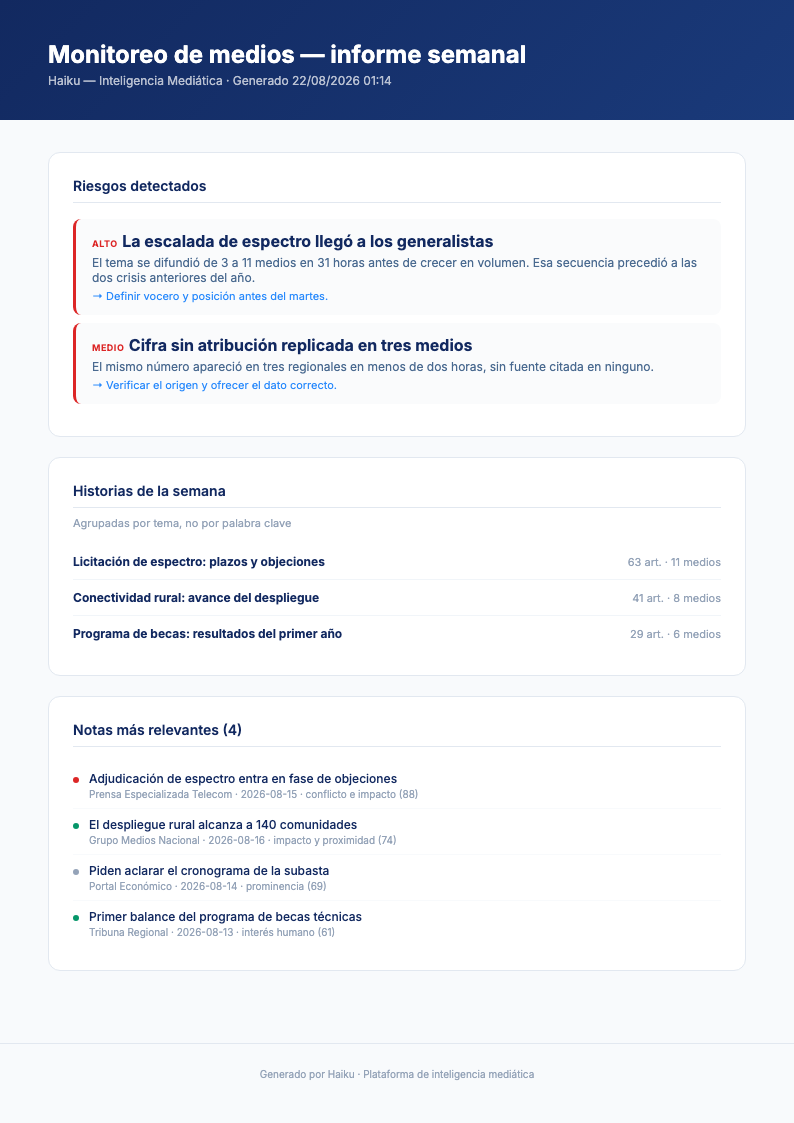
It goes out at the hour you set, summary on top and evidence underneath. This is a real sample generated by the platform, with example data.
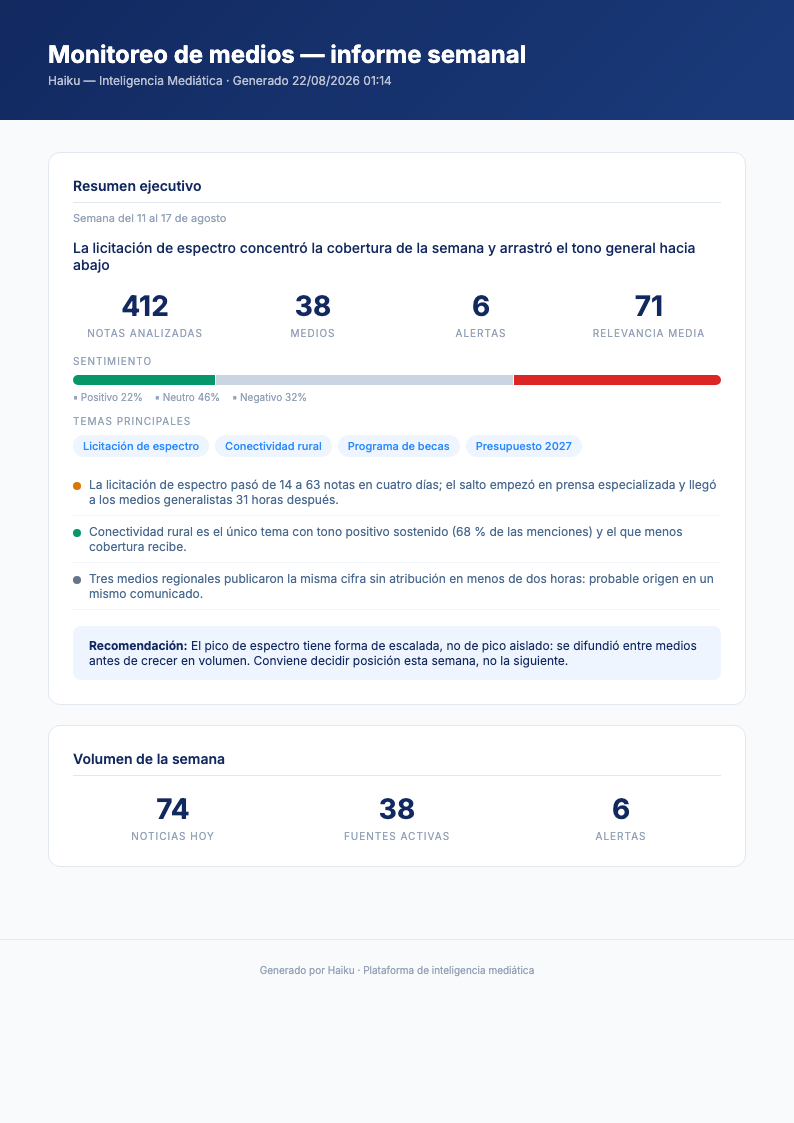
3 pages · PDF · no email required
Frequently asked
Media intelligence is the systematic analysis of press coverage to explain what is being said about an organisation, who is saying it and where it is heading. It differs from traditional media monitoring in that it doesn’t hand you clippings: it hands you interpretation — tone, actors, framing, risk — that you can decide on.
They are a global catalog of outlets ranked by country, type and reach, from which each institution picks what it wants to monitor. Haiku discovers each outlet’s feed automatically and, when an outlet doesn’t publish one, generates it by reading the site. Every source is watched for frequency and health: one that stops bringing articles is flagged, not assumed fine.
Yes. The catalog is global and monitoring is configured per country, so an organisation can follow several at once. What is specific to Costa Rica is the legislative tracking; the rest of the product doesn’t depend on the country.
Where the team already works: email and Telegram alerts when something crosses a threshold, a daily digest, and scheduled reports that go out on their own at whatever cadence you set. Reports export to PDF, PowerPoint and Excel, and every article has a public link to share without granting platform access.
Analysis runs on the full Spanish text, untranslated: translating before analysing is where irony and political nuance get lost. Every article returns tone, actors, concepts and category, and tone always comes with its evidence alongside, so it can be checked rather than believed. When the system can’t judge something, it leaves it blank instead of calling it «neutral».
From press monitoring we store what outlets already published. In social listening the line is sharper: for the profiles an institution chooses to follow we store what they posted, but for third-party comments we store neither author, nor text, nor link — only the derived trait, and the table has no such columns. It isn’t a policy: it’s the schema.
Pricing
Pricing depends on number of monitored sources, KPI domains, user seats, and deployment model. We work with multi-year public-sector budgets and standard PR-agency retainers.
Start anticipating it.
Every day without Haiku is a day your team spends hours on what AI can do in seconds.
No credit card · No commitment · Response within 24h
See how Haiku can transform your media intelligence. We'll be in touch within 24 hours.